bolt grade markings
Bolt Grade Markings and Strength
How to read a bolt head: the radial lines and stamped numbers that identify a grade, what each grade is made from, and the minimum tensile strength behind it. Covers the SAE J429 inch grades, the ISO 898-1 metric property classes, the ASTM structural and anchor specifications, and the stainless classes.
Upload your drawing (STEP, IGES, DWG, DXF, PDF) — we return DFM feedback and a quote within 24 hours.
- Tolerance
- ±0.01 mm
- MOQ
- From 50 pcs
- Sample
- 5–10 days
- Production
- 25–35 days
- Documents
- MTR + pre-shipment photos
What a grade actually guarantees
A bolt grade is a material and processing specification, not a general seal of quality. What it commits to is narrow and mechanical: a minimum tensile strength, a minimum yield (or proof) strength, and a hardness range, each verified by a standard test method. Those numbers tell you how much static load the shank will carry before it stretches or breaks. What a grade does not tell you is just as important. It says nothing about corrosion resistance, temperature behaviour, plating adhesion, or thread fit — those are governed by separate specifications. Nor does a marking prove any given batch was made correctly; that is the job of the accompanying material certificate (MTR). Read the marking as a statement about strength, and nothing more.
Reading an inch grade from the head
Inch-series bolts produced to SAE J429 carry a radial-line code on the head. No lines means Grade 2, the general-purpose low-carbon choice. Three radial lines mean Grade 5, a quenched-and-tempered medium-carbon steel. Six radial lines mean Grade 8, a quenched-and-tempered medium-carbon alloy steel at higher strength. More lines mean more strength, but also a harder part more sensitive to hydrogen from plating. Count the lines you can see, not the class you assume. The full strength values sit in the inch-grades table on this page, so use it instead of memorising. Remember that the same line code can appear on parts written to other standards — a drawing should name the specification, not just “Grade 8”.
Reading a metric property class from the head
Metric bolts carry a two-digit property class stamped on the head, defined in ISO 898-1. The first digit is one-tenth of the nominal tensile strength in megapascals; the second is the ratio of yield to tensile strength, also expressed as a tenth. So 8.8 means a minimum tensile of 800 MPa and a yield of 0.8 × 800 = 640 MPa, while 12.9 means 1200 MPa tensile and 1080 MPa yield. The classes run from 4.6, a soft plain low-carbon steel, through 12.9, an alloy steel that is quenched and tempered. The metric-property-classes table on this page lists each class with its strength. The second digit is a ratio, not a separate strength: 10.9 and 12.9 share the 0.9 ratio but differ in carbon and heat treatment.
Structural bolting: A325, A490 and F3125
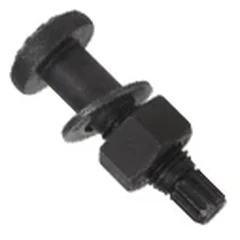
For structural steel connections in building frames and bridges, the two workhorse specifications were ASTM A325, the medium-strength bolt for most joints, and ASTM A490, the higher-strength bolt for slip-critical and heavier-loaded joints. Because the two overlapped and were usually specified together, ASTM consolidated them into ASTM F3125, which now carries A325 and A490 as grades alongside weathering and other steel grades. In practice an engineer still writes “A325” or “A490” out of habit; F3125 is the umbrella that holds them. These parts use their own marking scheme — a manufacturer mark plus the grade — rather than radial lines or a property-class number. When a drawing names A325 or A490, quote to the matching F3125 grade. The strength figures for the structural grades appear in the inch-grades table on this page.
Stainless classes and why they are marked differently
Stainless bolts are marked differently because the reason you buy them is different. The ISO 898-1 classes are written around strength, so a stronger bolt means harder, more brittle steel. Stainless steel is bought for corrosion resistance, and its strength is set by the alloy and the amount of cold work, not by quench-and-temper hardening. ISO 3506-1 therefore uses its own code: a letter for the alloy family — A2 for the 18-8 type, A4 for the molybdenum-bearing type — followed by a number for strength. A2-70 and A4-80 are the common classes, the number being one-tenth of the tensile strength in MPa: 700 and 800. The stainless-classes table on this page shows how the letter-and-number code maps to strength. Do not substitute an ISO 898-1 class number for a stainless code; a Grade 8 and an A2-80 are not interchangeable.
Matching a grade to your application
Choose the grade for the load, then check every other requirement separately. Low-stress assembly and general hardware often use Grade 2 or classes 4.6 and 5.8. Machinery and automotive joints under moderate load and vibration lean on Grade 5 or class 8.8. High-strength, weight-sensitive joints move to Grade 8 or classes 10.9 and 12.9. Outdoors, in washdown areas or near salt, stainless A2 or A4 wins even at lower strength, because a rusted Grade 8 fails long before an A4-80. Two cautions: high-strength parts are more sensitive to hydrogen embrittlement from plating, and a soft nut under a hard bolt caps the assembly at the nut’s strength. When the choice is unclear, send the loads and environment with your request for a quote and we will help you settle it.
Producing a marked part to a grade
A grade is a process specification the customer names, not something we assign. When your drawing calls for a specific class, we produce to that class’s material and process requirements: the correct starting alloy, the specified heat treatment route, and the head marking the standard requires. Starting stock comes from the materials we run daily — carbon steel 1045, 1215 and 12L14; alloy steel 4130 and 4140; and stainless 301, 303, 304, 304L, 316, 316L, 410, 416 and 17-4PH — with heat treatment and plating handled in-house or through our vetted partner network. We hold ±0.01 mm on features that locate, seal or fit, with ISO 2768-m as the general tolerance. What we ship is the material certificate (MTR) for the lot and pre-shipment photos — the record that the raw material matches the grade you named. See our materials, custom bolts and tolerances pages for the drawing-to-part flow.
Metric property classes — head marking and strength (ISO 898-1)
| Class | Head marking | Nominal tensile (MPa) | Minimum yield (MPa) | Typical material |
|---|---|---|---|---|
| 4.6 | 4.6 | 400 | 240 | Low carbon steel |
| 4.8 | 4.8 | 420 | 340 | Low carbon steel |
| 5.8 | 5.8 | 520 | 420 | Low carbon steel |
| 8.8 | 8.8 | 800 | 640 | Medium carbon steel, quenched and tempered |
| 10.9 | 10.9 | 1040 | 940 | Alloy steel, quenched and tempered |
| 12.9 | 12.9 | 1220 | 1100 | Alloy steel, quenched and tempered |
Property classes are marked on the head. Tensile and yield values are the nominal values for sizes above M16; proof load and yield vary with diameter, so confirm the exact requirement against ISO 898-1 or your drawing.
Inch grades — head marking and strength (SAE J429 / ASTM)
| Grade / spec | Head marking | Size range (in) | Min tensile (ksi) | Typical material |
|---|---|---|---|---|
| SAE J429 Grade 2 | No radial lines | 1/4 – 3/4 | 74 | Low carbon steel |
| SAE J429 Grade 2 | No radial lines | over 3/4 – 1-1/2 | 60 | Low carbon steel |
| SAE J429 Grade 5 | 3 radial lines | 1/4 – 1 | 120 | Medium carbon steel, Q&T |
| SAE J429 Grade 5 | 3 radial lines | over 1 – 1-1/2 | 105 | Medium carbon steel, Q&T |
| SAE J429 Grade 8 | 6 radial lines | 1/4 – 1-1/2 | 150 | Alloy steel, Q&T |
| ASTM A307 Grade A | A307 or A | 1/4 – 4 | 60 | Low carbon steel |
| ASTM A325 Type 1/2/3 | A325 + 3 radial lines | 1/2 – 1 | 120 | Medium carbon, Q&T |
| ASTM A325 Type 1/2/3 | A325 + 3 radial lines | 1-1/8 – 1-1/2 | 105 | Medium carbon, Q&T |
| ASTM A490 Type 1/3 | A490 + 6 radial lines | 1/2 – 1-1/2 | 150 | Alloy steel, Q&T |
| ASTM A354 Grade BD | A354 BD | 1/4 – 4 | 150 | Alloy steel, Q&T |
| ASTM A449 | A449 | 1/4 – 1 | 120 | Medium carbon, Q&T |
| ASTM A449 | A449 | over 1 – 1-1/2 | 105 | Medium carbon, Q&T |
Grade markings are raised or indented radial lines on the head. Tensile values are minimums for the size range shown. ASTM A325 and A490 have been consolidated into ASTM F3125.
Stainless steel fastener classes (ISO 3506-1)
| Class | Steel family | Min tensile (MPa) | Typical use |
|---|---|---|---|
| A2-50 | 304 (18-8) | 500 | General purpose, low load |
| A2-70 | 304 (18-8) | 700 | General purpose, most common |
| A2-80 | 304 (18-8) | 800 | Higher strength, cold worked |
| A4-50 | 316 | 500 | Marine and chemical, low load |
| A4-70 | 316 | 700 | Marine and chemical |
| A4-80 | 316 | 800 | Marine and chemical, higher strength |
A2 is the 304 family and A4 the 316 family. The number after the dash is the minimum tensile strength in MPa. Head marking carries the class, for example A2-70.
Need a size or thread that is not listed? Send the drawingand we will confirm what we can hold.
Frequently asked questions
What do the radial lines on a bolt head mean?
They identify the SAE J429 inch grade. No lines is Grade 2, three lines is Grade 5, and six lines is Grade 8. More lines means higher tensile strength.
What is the difference between Grade 5 and Grade 8 bolts?
Grade 8 uses a medium-carbon alloy steel and is quenched and tempered to a higher strength than Grade 5. Grade 8 is stronger, but harder and more sensitive to hydrogen embrittlement from plating.
What does the second number in 8.8 or 10.9 mean?
It is the ratio of yield strength to tensile strength expressed as a tenth. In 8.8 the ratio is 0.8, so the minimum yield is 0.8 × 800 MPa, or 640 MPa.
Is 8.8 stronger than Grade 5?
In tensile terms, yes. 8.8 specifies an 800 MPa minimum tensile, above Grade 5. Always compare against the named standard rather than assuming direct equivalence.
What is the strongest common metric bolt class?
12.9, at 1200 MPa minimum tensile and 1080 MPa yield, is the highest common ISO 898-1 class. It requires alloy steel and careful plating control.
What is the difference between A325 and A490 bolts?
Both are structural bolts now carried under ASTM F3125. A490 is the higher-strength grade, used where more load or slip-critical behaviour is required.
Is A325 the same as F3125?
F3125 is the consolidated specification that now contains A325 and A490 as grades. A drawing that names A325 is met by the matching F3125 grade.
What does A2-70 mean on a stainless bolt?
A2 is the austenitic 18-8 alloy family and 70 means 700 MPa minimum tensile. The letter names the alloy, the number the strength.
What is the difference between A2 and A4 stainless?
A4 adds molybdenum, which improves resistance to chlorides and salt. A4-80 is the common higher-strength molybdenum-bearing class.
Can I use a stainless bolt where a Grade 8 is specified?
Only if the drawing permits it. A stainless bolt carries a different strength code and lower strength than Grade 8, so substituting changes the joint's capacity.
Does the grade mark prove the bolt was made correctly?
No. The mark states the specification the part is produced to. The material certificate (MTR) for the lot is the record that the raw material matches that specification.
Can you manufacture bolts to a specific grade and marking?
Yes. Name the class on the drawing and we produce to its material and process requirements, including the required head marking, and ship the material certificate (MTR) and pre-shipment photos.
Send your drawing — quote in 24 hours
DFM feedback, material certificates and pre-shipment photos come with every order.