titanium machined parts
Titanium CNC Machined Parts
Titanium machined parts machined to your drawing, with grade selection advice and material certificates supplied with the order.
Upload your drawing (STEP, IGES, DWG, DXF, PDF) — we return DFM feedback and a quote within 24 hours.
- MOQ
- From 50 pcs
- Sample
- 5–10 days
- Production
- 25–35 days
- Finishing
- Through partner network
- Documents
- MTR + pre-shipment photos
Grades we machine
We machine titanium parts in the two grades that cover most commercial work: Grade 2 and Grade 5 (Ti-6Al-4V), both part of our materials range. Grade 2 is commercially pure titanium, chosen for its corrosion behaviour and formability in marine, chemical and general hardware where strength is not the deciding factor. Grade 5 is the aluminium-vanadium alloy Ti-6Al-4V, the most widely specified titanium grade, chosen for its strength-to-weight behaviour in aerospace, medical and high-performance structural parts.
Grade 2 is the corrosion-and-formability end of the range. Because it is commercially pure rather than alloyed, it is specified where the part has to hold up in seawater or aggressive chemical environments and where the geometry benefits from a metal that forms and fabricates readily. Marine fittings, chemical-hardware parts and general corrosion-resistant components are its natural home, and it is the grade to reach for when corrosion behaviour matters more than outright strength.
Grade 5, or Ti-6Al-4V, is the strength-to-weight grade. Its aluminium and vanadium alloying gives it the combination of high strength and low density that makes titanium useful in demanding applications, and it is the grade behind most structural, aerospace and medical titanium parts. When a bracket, housing or fastener has to be strong and light at the same time, Grade 5 is the working assumption, and it is the grade we machine most often.
The choice between them follows from why titanium was specified at all. If the driver is weight — a part that must be light and strong — the drawing almost always points to Grade 5. If the driver is corrosion — a part that must survive seawater or chemicals — Grade 2 is the common call. In practice the grade on your drawing decides the route: Grade 2 cuts more freely, while Grade 5 is tougher and harder on tooling. We confirm the grade in DFM feedback and match speeds, feeds and tooling to it so both grades machine predictably to ±0.01 mm on precision features with ISO 2768-m as the general tolerance.
One honest point up front: titanium is rarely the cheap answer. Its place is where weight or corrosion justifies the price, not where unit cost is the deciding factor. When the drawing specifies titanium, there is usually a real reason behind it, and our job is to machine that grade cleanly and predictably rather than to steer you to a different metal.
Machining characteristics
Titanium machines differently from aluminium or steel. Its low thermal conductivity keeps heat at the cutting edge instead of carrying it away through the chip, so the tool runs hot and wears faster. We manage that with rigid setups, sharp tooling, controlled speeds and feeds, and appropriate coolant, and we plan the cut sequence so thin walls and deep pockets stay stable.
Titanium also work-hardens if the tool rubs instead of cutting, and the fine, hard chips it produces are abrasive on the tool. That is why the cutting data is kept conservative — slower speeds and controlled feed rates protect the edge — and why titanium parts take longer to machine than the same shape in aluminium or steel. Removal rates are lower because the cutting parameters are held back to protect the tool, not because the machine is the limit.
There is also a fire risk with fine titanium swarf, which can ignite if it is allowed to build up dry and hot at the cut. We keep chips controlled and cooled, avoid letting fine swarf accumulate, and handle titanium waste carefully as part of every job. Chip control and coolant are not optional extras on titanium; they are part of how the part is planned before machining starts.
All of these factors add up on cost: the material itself is more expensive than aluminium or steel, cycle times are longer, and tool wear is higher. These factors, not the geometry, are usually what push a titanium part’s unit price above the same shape in another metal. We keep the cost as low as the part allows by choosing the process route carefully — CNC milling for brackets, housings and pockets, and CNC turning for shafts, fittings and fasteners — within an 800 × 500 mm milling envelope.
Typical parts made from this material
Titanium is specified where weight, corrosion or both decide the material. Typical orders include:
- Aerospace brackets, housings and structural fittings where strength-to-weight matters.
- Medical device components machined from Grade 5 where the drawing calls for titanium.
- Marine hardware, fittings and fasteners where seawater corrosion rules out many other metals.
- General fasteners, shafts and housings where the drawing specifies titanium.
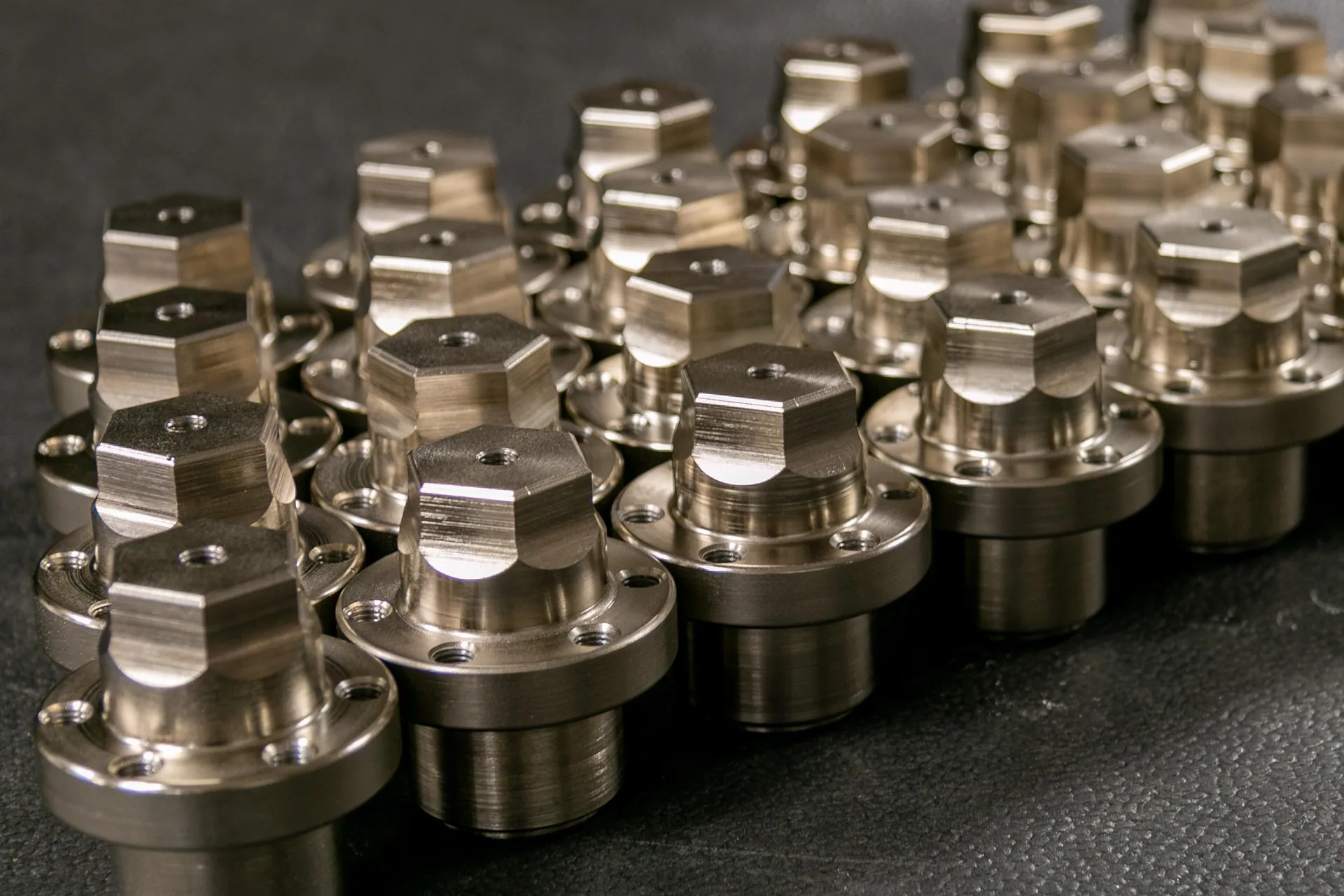
Grade 2 shafts and fittings are common where corrosion matters more than strength, while Grade 5 housings and brackets carry the structural side of the same assemblies. Threaded titanium fasteners are usually Grade 5 where the thread has to hold its form under load. Orders start from 50 pieces per style and material, samples from 1 piece, and a material certificate (MTR) ships with every batch. Send the drawing through request a quote and we will confirm the grade, the finish and the lead time in DFM feedback.
Surface finishes that pair well
Titanium parts are often left in the machined condition, but a finish adds colour, corrosion behaviour or wear resistance where the drawing calls for it. Titanium anodizing builds a coloured oxide layer, passivation cleans and conditions the surface, and PVD coatings such as titanium nitride add a hard, wear-resistant surface. Finishes are applied through our vetted partner network, managed under one quality process, and quoted with the same order.
Because finishing can change a thread or bore, we keep thickness and masking in mind for mating features. A colour anodize is often chosen for identification rather than protection, while passivation and PVD are specified where surface behaviour matters. For more options, see our surface finishes guide.
Specifications
| Materials | Titanium Grade 2, Grade 5 (Ti-6Al-4V) |
|---|---|
| Tolerance | ±0.01 mm on precision features |
| General tolerance | ISO 2768-m unless stated on the drawing |
| Processes | CNC turning, CNC milling |
| Stock forms | Round bar, plate and block |
| Threads | Metric and inch, internal and external |
| Typical parts | Brackets, housings, fittings, fasteners, shafts |
| Finishes | Anodizing, passivation, PVD through partner network |
| MOQ | From 50 pieces (samples from 1) |
| Sample lead time | 5–10 days |
| Production lead time | 25–35 days |
| Quote | Within 24 hours with DFM feedback |
| Milling envelope | 800 × 500 mm |
| Monthly capacity | Over 100,000 parts |
| Documents | Material certificate (MTR) + pre-shipment photos |
Titanium grades we machine
| Grade | Type | Condition | What it is chosen for | Typical parts |
|---|---|---|---|---|
| Grade 2 | Commercially pure titanium | Annealed | Corrosion resistance and formability rather than strength — the grade for aggressive chemical and seawater service | Chemical and marine fittings, heat-exchanger parts, medical hardware |
| Grade 5 (Ti-6Al-4V) | Alpha-beta alloy | Annealed | The high strength-to-weight grade, and the one most often specified when titanium is chosen for structural reasons | Aerospace and structural parts, high-strength fasteners, housings and brackets |
Grade 2 and Grade 5 cover most commercial work. Grade 5 is harder on tooling and needs different cutting data from Grade 2.
Need a size or thread that is not listed? Send the drawingand we will confirm what we can hold.
Frequently asked questions
What titanium grades do you machine?
We machine Grade 2 (commercially pure) and Grade 5 (Ti-6Al-4V). Grade 2 is chosen for corrosion behaviour and formability, and Grade 5 for its strength-to-weight behaviour in aerospace, medical and structural parts.
When should I choose Grade 5 over Grade 2?
Choose Grade 5 where strength-to-weight is the reason for using titanium, such as structural and high-performance parts. Choose Grade 2 where corrosion resistance matters more than strength, such as marine and chemical hardware.
Why does titanium cost more to machine?
Titanium's low thermal conductivity keeps heat at the cutting edge, so tools run hot and wear faster, and it work-hardens if the tool rubs. Material cost, cycle time and tool wear together make it more expensive than the same part in aluminium or steel.
Do you machine titanium for medical components?
Yes. We machine Grade 5 medical device components to your drawing. Send the grade, geometry and any finish callout so we can review the requirement in DFM feedback.
Can you machine titanium brackets and housings?
Yes. Brackets, housings and structural fittings are typical titanium work, machined by CNC milling and turning to ±0.01 mm on precision features with ISO 2768-m as the general tolerance.
Do you offer titanium anodizing?
Yes. Titanium anodizing, passivation and PVD coatings are available through our vetted partner network, managed under one quality process, and quoted with the same order.
What tolerances can you hold on titanium parts?
We hold ±0.01 mm on precision features and work to ISO 2768-m as the general tolerance. We plan tooling and speeds carefully because titanium work-hardens and runs hot at the cut.
Do you provide material certificates for titanium?
Yes. Every batch ships with a material certificate (MTR) and pre-shipment photos, so the grade and condition are recorded before dispatch.
What is your MOQ for titanium parts?
Orders start from 50 pieces per style and material, with samples available from 1 piece. Samples ship in 5–10 days and production in 25–35 days after drawing approval.
Why is titanium used in marine hardware?
Titanium resists corrosion in seawater, so it is specified for marine fittings, fasteners and hardware where other metals would degrade. We machine it in Grade 2 for general marine parts and Grade 5 where strength is also required.
Can you apply a PVD coating to titanium?
Yes. PVD coatings such as titanium nitride are available for a hard, wear-resistant surface. Coatings are applied through our vetted partner network and quoted with the same order.
How fast can I get titanium samples?
Samples ship in 5–10 days and production in 25–35 days after drawing approval. Quotes with DFM feedback come back within 24 hours.
Is titanium ever the cheap answer?
Rarely. Titanium costs more as raw material than aluminium or steel, cuts with conservative parameters, and wears tooling faster, so it is almost never the lowest-price route. Its place is where weight reduction or corrosion behaviour justifies the extra cost, not where unit price is the deciding factor.
How do you manage the fire risk of fine titanium swarf?
Fine titanium swarf can ignite, so we keep chips controlled and cooled at the cut and avoid letting fine swarf build up. Chip control, coolant and careful handling are part of how we plan every titanium job before machining starts.
Does Grade 2 machine differently from Grade 5?
Yes. Grade 2 is commercially pure and cuts more freely, while Grade 5 is tougher and harder on tooling. We confirm the grade in DFM feedback and match speeds, feeds and tooling to it, so both machine predictably to the same tolerances.
Send your drawing — quote in 24 hours
DFM feedback, material certificates and pre-shipment photos come with every order.