custom nuts
Custom Nuts — Specialty & Non-Standard Nuts
We manufacture custom nuts to your drawing — turned, milled and finished in one factory, with a material certificate and pre-shipment photos before the goods ship.
Upload your drawing (STEP, IGES, DWG, DXF, PDF) — we return DFM feedback and a quote within 24 hours.
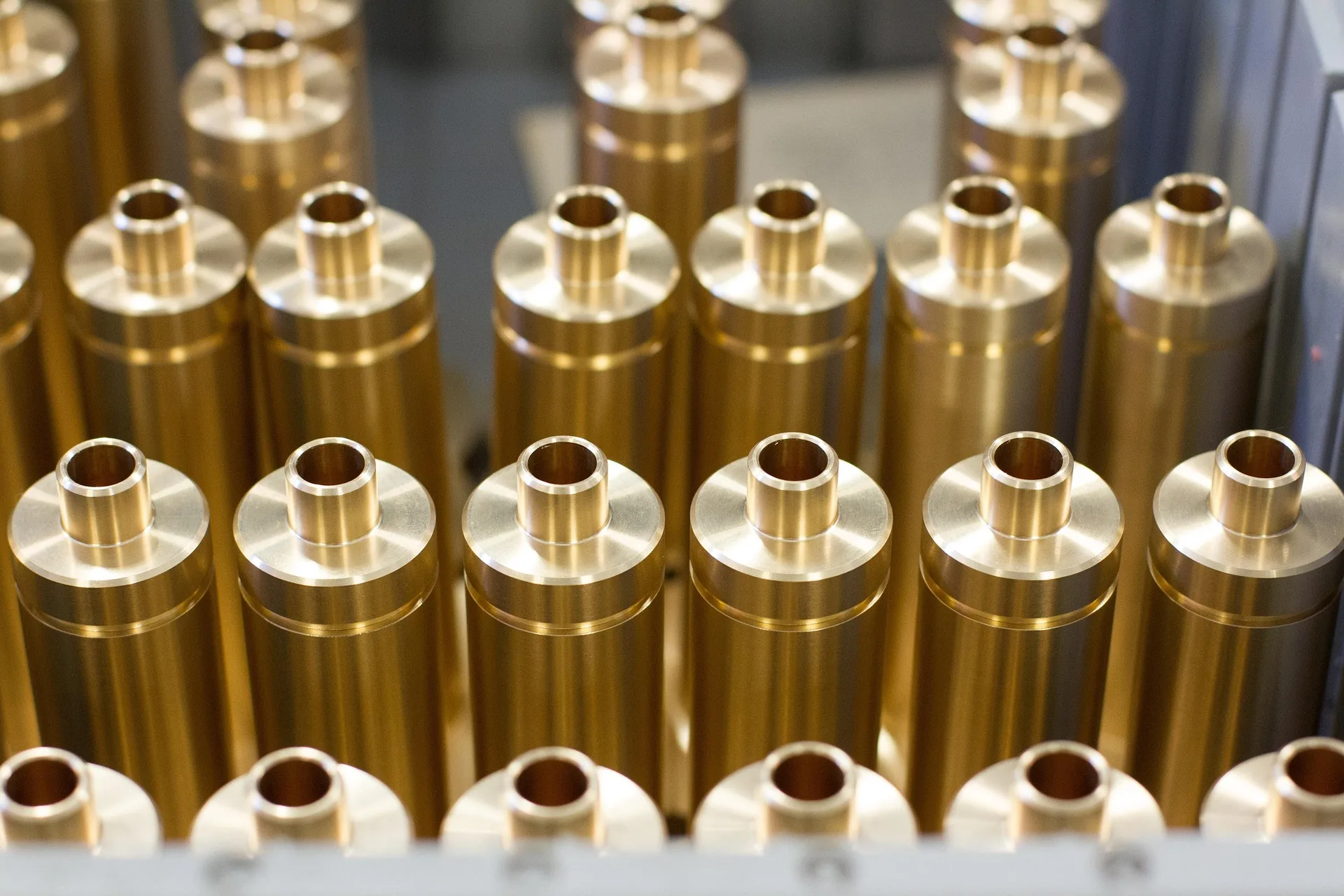
- Tolerance
- ±0.01 mm
- MOQ
- From 50 pcs
- Sample
- 5–10 days
- Production
- 25–35 days
- Documents
- MTR + pre-shipment photos
What this part is and where it is used
Custom nuts are internally threaded fasteners that mate with a bolt, stud or threaded rod to clamp parts together. They are machined to your drawing, so the thread size and pitch, the wrenching form and the material are set by the print. Nuts and fasteners of this type carry load on the far side of a joint — the nut threads onto the shank and, with a washer, seats against the part surface.
Buyers order custom nuts when a standard size, form or material does not exist: a non-standard thread, a shoulder for spacing, a coupling nut to join two studs, or an alloy such as brass or 316L. They are usually paired with matching parts from our custom bolts and custom washers pages.
Types of custom nuts we manufacture
We machine the common forms to print:
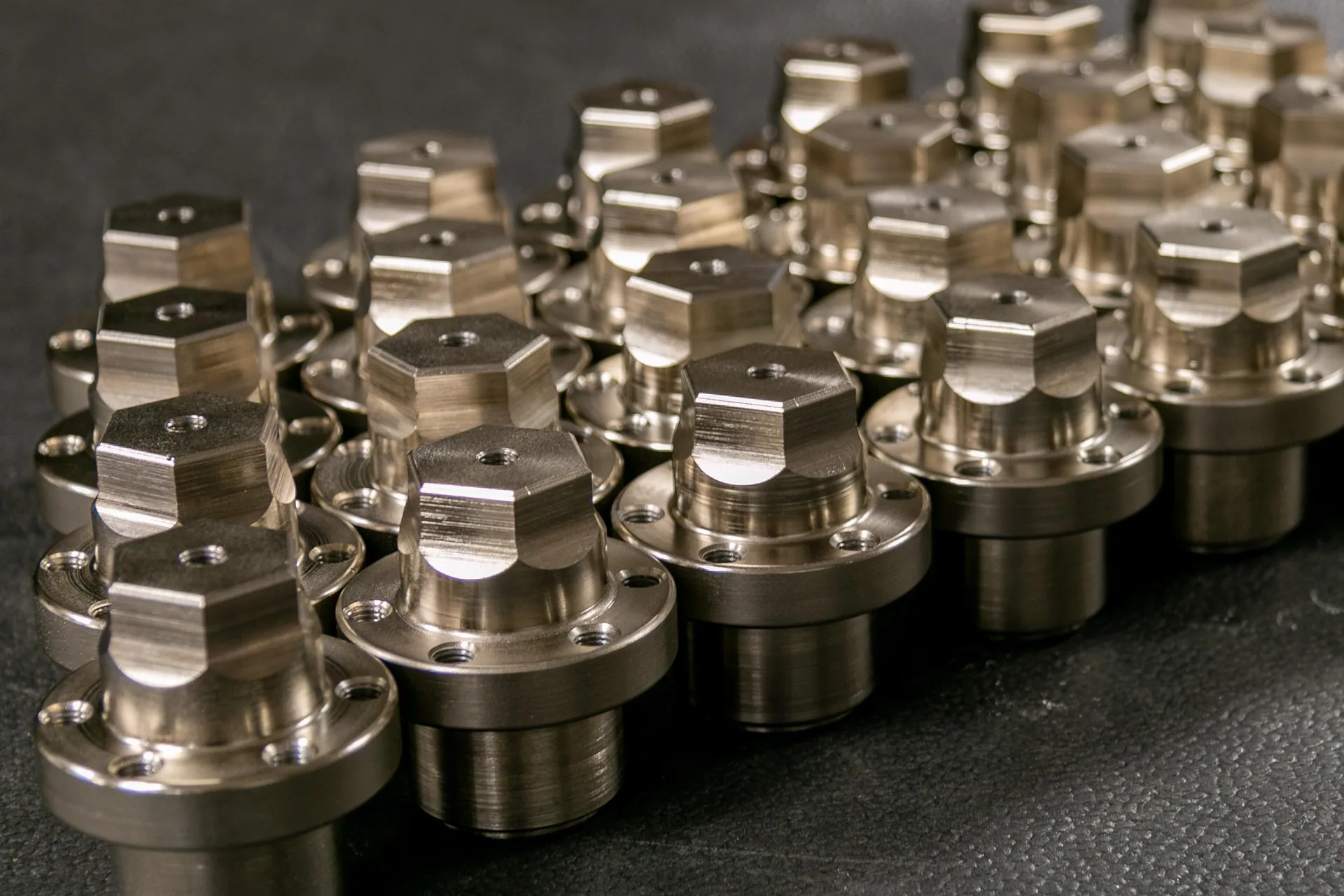
- Hex nuts — the standard wrenching form, in standard and thin profiles.
- Flange nuts — an integrated bearing face spreads load and removes the need for a separate washer.
- Coupling nuts — long bodies that join two threaded rods end to end.
- Jam and lock nuts — slim nuts used to lock a second nut in position.
- Shoulder nuts and special nuts with custom heights, collars and wrenching forms.
A hex nut fastener, a hex nut washer assembly, or a shoulder nut with a locating collar is one drawing away. We are a nut manufacturer that works from your print, not from a stock bin.
Nut styles and locking methods
Beyond the standard hex nut, we cut the styles that solve a specific joint problem:
- Hex nuts — the general wrenching form, in standard and thin profiles.
- Nylon insert lock nuts — a polymer ring grips the thread to resist loosening under vibration.
- All-metal lock nuts — a deformed thread or crimped collar locks without a polymer insert, for higher-temperature joints.
- Flange nuts — an integrated bearing face spreads load and drops the separate washer.
- Cap nuts (acorn nuts) — a closed dome covers the stud end to protect the thread and finish the joint.
- Wing nuts — hand-tightened for tool-free adjustment and quick assembly.
- Slotted and castle nuts — radial slots take a cotter pin for a positive mechanical lock.
Each style is machined from bar to your print, so the locking feature, height and wrenching form are set by the drawing rather than a stock bin. They pair with matching custom bolts and custom washers from the same shop.
Thread forms and standards
Threads are cut to match the standard your assembly is built around. We work to metric (M) coarse and fine pitches and to inch UNC and UNF series, with BSP and NPT available for pipe-facing nuts. Where the drawing references a standard we follow DIN or ANSI/ASTM, and ISO references are handled the same way. Tolerance classes such as 6H for the internal thread are set from the print, and the pitch or threads-per-inch is confirmed against the drawing before we cut.
Because we machine the thread rather than forming it, a non-standard pitch, a left-hand thread or a one-off size is the same work as a common one — the nut simply follows your print. See our thread standards guide for the full list of options.
Dimensions we work to
Diameter, thread size and height are set by your drawing — we quote each nut against the print rather than a fixed size table, so there is no catalogue range to fit inside. Precision features such as a collar, a shoulder or a bearing face are held to ±0.01 mm, and general dimensions to ISO 2768-m unless your drawing states otherwise.
Small runs and production runs follow the same route: orders start from 50 pieces, samples take 5–10 days and production 25–35 days after drawing approval. Where the part suits it, we cut the thread and wrenching form in one turning or milling setup. Send the drawing and we return DFM feedback with a quote within 24 hours — see our tolerances, drawing requirements and how to order pages.
Materials, threads and finishes
Common materials are aluminium 2024, 5052, 6061 and 7075; stainless steel 303, 304, 304L, 316, 316L and 17-4PH; carbon and alloy steel 1045, 1215, 4140, D2 and O1; brass, copper and bronze; and titanium. Brass, bronze and stainless steel suit corrosion-facing and instrument work, and 316L or 17-4PH is the pick where a nut has to survive both chlorides and load; the full grade list is on our materials index, with detail on the stainless steel parts, aluminium parts, steel parts, brass and copper parts and titanium parts pages.
Threads are cut to metric or inch references, or to DIN and ANSI/ASTM standards — our thread standards page lists the options. We cut coarse and fine pitches and left-hand threads, so the nut matches your bolt or stud exactly. Finishing runs through our vetted partner network under one quality process: zinc plating, black oxide and passivation, among others.
Industries and applications
Industrial nuts and machine nuts appear in automotive, aerospace, oil and gas, hydraulic and pneumatic and electronics hardware assemblies. Coupling nuts and flange nuts serve structural ties and panel mounting, while shoulder nuts handle spacing and pivot positions.
What cap nuts are and where they are used
A cap nut closes over the end of a thread. The dome does three jobs at once: it hides the exposed thread end so the joint finishes cleanly, it keeps water and dust out of the thread, and it removes the sharp protrusion that a plain hex nut leaves behind — which matters on anything a person handles. An acorn nut is the same part under its profile name, and the two words are used interchangeably in drawings and purchase orders. We manufacture cap nuts to your drawing in our own factory in Qidong City, Jiangsu Province, China, and they ship with a material certificate (MTR) and pre-shipment photos. Typical use is exposed fittings on furniture and playground equipment, hand tools, sports and marine hardware, and any visible joint where the thread end has to be covered.
Patterns we manufacture
The pattern comes from the drawing, and the dome is the part that has to be right:
- Domed acorn nut — the standard closed dome, for covering a protruding thread end.
- Hex cap nut — a hex body with a closed dome, so it can be driven with a wrench rather than by hand.
- Long acorn nuts — an extended dome for a longer bolt end, giving more usable thread engagement than a standard profile.
- Acorn cap nuts — a high-crown dome with a smaller base, common on decorative and furniture fittings.
- Flange cap nut — an integrated bearing face under the dome that spreads load and removes the need for a separate washer.
Where volume justifies forming, the dome is formed; where the quantity is small or the profile is special, it is machined from bar instead. Either route gives the same outside profile, and we say which one the drawing suits. These parts run alongside our custom nuts, lock nuts and custom washers programmes.
Thread engagement and dome depth
The dome is blind, so the usable thread length is shorter than on a plain nut of the same height — that is the one dimension that catches buyers out. Tell us the bolt length or the engagement the joint needs and we set the blind depth against it, rather than assuming a standard profile will cover the thread. A long acorn nut exists precisely for joints where the bolt end protrudes further than a standard dome can swallow. Send the bolt length with the drawing and the two are matched in DFM.
Dimensions and how the joint is presented
Across-flats, overall height, dome radius and blind depth all come from your drawing, so there is no catalogue ceiling on the size we will quote. General dimensions are held to ISO 2768-m unless the print states otherwise, and precision features — a bearing face, a dome profile that has to match a mating part, a controlled wall thickness at the dome — are held to ±0.01 mm. Because a cap nut is usually the visible half of a joint, confirm the assembled appearance at sampling rather than flat on the bench. A 50-piece first batch validates the thread and the dome, then production repeats it in 25–35 days after approval. Send a STEP, DWG or PDF and we confirm the dimensions against our drawing requirements before quoting.
Why order cap nuts from our factory
We produce and tap cap nuts in our own factory in Qidong City, Jiangsu Province, China — thread, body and dome are produced under one route. General work is held to ISO 2768-m unless stated on the drawing, with precision features to ±0.01 mm. Orders start from 50 pieces; samples take 5–10 days and production 25–35 days. Monthly capacity runs over 100,000 parts, scheduled flexibly per order. Send a drawing and we return DFM feedback with a quote within 24 hours, then ship with a material certificate (MTR) and pre-shipment photos. WhatsApp us or use the quote form.
What lock nuts are and where they are used
A lock nut is the half of a fastened joint that keeps it from backing off. A plain hex nut clamps and relies on preload alone; a lock nut adds a locking element — a nylon collar or a deformed metal section — so vibration, thermal cycling or a joint that is opened and closed cannot walk the nut loose. We manufacture lock nuts to your drawing in our own factory in Qidong City, Jiangsu Province, China, and they ship with a material certificate (MTR) and pre-shipment photos. Typical use is anywhere a joint has to stay tight under movement: pump and motor mounts, brackets, machine guards, valve and manifold connections, agricultural and marine assemblies, and panel hardware.
Types of lock nuts we manufacture
The pattern is set by the drawing, not picked from a catalogue bin:
- Nylon insert (nyloc) lock nut — a nylon collar grips the thread. Smooth to run down, quiet in service, and the default where the joint stays at moderate temperature.
- All-metal lock nut — a deformed or slotted metal section provides prevailing torque with no polymer in the joint, which is the usual choice where service temperature rules nylon out.
- Hex lock nut and hex jam nut — a standard hex body with a locking feature or a reduced height for locking against another nut.
- Flange lock nut — an integrated bearing face that spreads load and removes the need for a separate washer.
- Collar lock nut — a raised collar carries the locking section, common on thin sheet and tube joints.
- Thin lock nut and reversible lock nut — reduced height for limited clearance, and a pattern that can be fitted either way up.
A special across-flats, a non-standard thread or a specific locking torque is routine rather than a gamble. These lock nuts and bolts are usually ordered together so the thread class matches, and they run alongside our custom nuts and custom washers programmes.
Threads, materials and finishes
Threads are tapped on our own floor to the form on your drawing. Metric lock nuts use M-series threads and inch parts use UNC or UNF; where a sealing thread is specified we work BSP and NPT. We reference metric, inch and DIN geometry rather than shipping from a catalogue, so your drawing takes precedence — see our thread standards guide. Tolerance class normally comes from the print.
Common materials are stainless 303, 304, 304L, 316 and 316L, steel 1045 and 1215, alloy steel 4140 where the drawing allows, brass and copper alloys, and aluminium 6061, 7075 and 2024; titanium Grade 2 and Grade 5 are quoted per drawing. Stainless covers corrosion and 4140 covers higher-strength clamping, so the grade follows the service rather than the other way round. Finishing — zinc plating, black oxide, passivation — runs through our vetted partner network under one quality process, on the same drawing as the thread.
Dimensions and locking behaviour
Across-flats, thickness, thread pitch and the height of the locking section all come from your drawing; there is no catalogue ceiling on the size of a lock nut we will quote. General dimensions are held to ISO 2768-m unless the print states otherwise, and precision features — a collar diameter, a bearing face or a controlled wall thickness — are held to ±0.01 mm. Where the drawing calls out a prevailing torque figure, tell us how it is measured and we will confirm the locking pattern against it rather than guessing. Small and large runs follow the same route: a 50-piece first batch validates thread fit and locking behaviour, then production repeats it in 25–35 days after approval. Send a STEP, DWG or PDF and we confirm the dimensions against our drawing requirements before quoting.
Why order lock nuts from our factory
We machine and tap lock nuts in our own factory in Qidong City, Jiangsu Province, China — thread, across-flats and locking section are produced under one route. General work is held to ISO 2768-m unless stated on the drawing, with precision features to ±0.01 mm. Orders start from 50 pieces; samples take 5–10 days and production 25–35 days. Monthly capacity runs over 100,000 parts, scheduled flexibly per order. Send a drawing and we return DFM feedback with a quote within 24 hours, then ship with a material certificate (MTR) and pre-shipment photos. WhatsApp us or use the quote form.
What an all metal lock nut is and where it is used
An all metal lock nut produces prevailing torque from the nut body itself. Instead of a polymer collar, the locking comes from a deformed thread section, an elliptical crimp or a slotted and castellated pattern, so there is no polymer anywhere in the joint. That matters in two situations: where service temperature would soften an insert, and where the joint is opened and closed often enough that a nylon collar would relax. We manufacture all-metal lock nuts to your drawing in our own factory in Qidong City, Jiangsu Province, China, and they ship with a material certificate (MTR) and pre-shipment photos. Typical use is exhaust and hot-side assemblies, hydraulic and pneumatic manifolds, machine frames, heavy-duty brackets and any joint specified to a prevailing torque figure .
Patterns we manufacture
The pattern is set by the drawing:
- Deformed thread lock nut — a crimped or elliptical section at the top of the nut gives prevailing torque on the bolt thread.
- Stover style lock nut — the classic all-metal prevailing torque pattern, with the locking section formed into the body.
- Hex slotted nut and castle nut — slots cut across the thread so a split pin or wire can lock the nut mechanically.
- Hex all-metal lock nut and hex jam — a standard hex body with the locking feature, or a reduced height for locking against another nut.
- Flange all-metal lock nut — an integrated bearing face that spreads load and removes the need for a separate washer.
A non-standard across-flats, a specific crimp depth or a controlled slot width is routine rather than a gamble. All-metal lock nuts are normally ordered with their bolts so the thread class and plating match — see custom bolts and custom screws.
All-metal or nylon insert: which one fits the joint
Both patterns solve the same problem, so the joint decides. An all-metal lock nut takes higher service temperature and generally survives more open-and-close cycles, because the locking feature is metal rather than a polymer that relaxes. A nylon insert lock nut runs down more smoothly, does not gall the thread and seals lightly against moisture in the thread, which suits assemblies that are built once and left alone. If the assembly runs hot or is serviced repeatedly, the metal pattern is the right call; if it does not, the insert pattern is more forgiving to assemble. Tell us the service condition on the drawing and we will quote the pattern that fits it.
Dimensions and locking behaviour
Across-flats, thickness, pitch and the height of the locking section all come from your drawing; there is no catalogue ceiling on the size we will quote. General dimensions are held to ISO 2768-m unless the print states otherwise, and precision features — a bearing face, a flange diameter or a controlled wall thickness — are held to ±0.01 mm. Where the drawing calls out a prevailing torque figure, tell us how it is measured and we set the crimp depth, slot width or deformed thread length against it rather than estimating. A 50-piece first batch validates thread fit and locking behaviour, then production repeats it in 25–35 days after approval. Send a STEP, DWG or PDF and we confirm the dimensions against our drawing requirements before quoting.
Why order all-metal lock nuts from our factory
We produce and tap all-metal lock nuts in our own factory in Qidong City, Jiangsu Province, China, under one route with the bolt they will run on. General work is held to ISO 2768-m unless stated on the drawing, with precision features to ±0.01 mm. Orders start from 50 pieces; samples take 5–10 days and production 25–35 days. Monthly capacity runs over 100,000 parts, scheduled flexibly per order. Send a drawing and we return DFM feedback with a quote within 24 hours, then ship with a material certificate (MTR) and pre-shipment photos. WhatsApp us or use the quote form.
What nylon insert lock nuts are and where they are used
A nylon insert lock nut — usually called a nyloc nut — carries a nylon collar at the top of the thread. Run the nut down and the collar is compressed by the bolt thread, gripping it and adding prevailing torque on top of the clamp load. That is the whole point: the joint resists vibration without a washer, a second nut or a thread locking compound, and the nut still runs down by hand. We manufacture nylon insert lock nuts to your drawing in our own factory in Qidong City, Jiangsu Province, China, tapped and staked on our floor, and they ship with a material certificate (MTR) and pre-shipment photos. Typical use is brackets, panels, machine guards, pump and motor mounts, electrical enclosures and any assembly that is built once and then shaken for years.
Patterns we manufacture
The pattern comes from the drawing, not from a catalogue bin:
- Standard hex nyloc nut — the default; a hex body with a nylon collar set into the top.
- Hex jam nyloc — reduced height for locking against another nut or in limited clearance.
- Flange nyloc nut — an integrated bearing face that spreads load and removes the need for a separate washer.
- Thin and low-profile nyloc — where stack height is tight.
- Collar and acorn styles — a raised collar or a closed dome, on request.
A special across-flats, a non-standard pitch or a specific collar height is routine. Nylon insert lock nuts are normally ordered with their bolts so the thread class and coating match — see custom bolts and custom screws.
Nylon insert or all-metal: which one fits the joint
The two locking methods solve the same problem in different ways, so the choice is usually made by the joint rather than by preference. A nylon insert holds with a polymer collar: it is smooth to run down, it does not gall the thread, it seals lightly against moisture in the thread, and it is quiet in service. An all-metal lock nut holds with a deformed or slotted metal section instead — no polymer in the joint, so it takes higher service temperatures and generally survives more open-and-close cycles. If the assembly runs hot, or if it will be serviced repeatedly, say so on the drawing and we will quote the metal pattern. If it does not, the nylon insert is the more forgiving part to assemble.
Threads, materials and finishes
Threads are tapped on our own floor to the form on your drawing. Metric nyloc nuts use M-series threads and inch parts use UNC or UNF; where a sealing thread is called out we work BSP and NPT. We reference metric, inch and DIN geometry rather than shipping from a catalogue, so your drawing takes precedence — see our thread standards guide.
Nut bodies come in stainless 303, 304, 304L, 316 and 316L, steel 1045 and 1215, brass and copper alloys, and aluminium 6061, 7075 and 2024; the nylon insert is supplied seated and staked as part of the finished nut. Stainless covers corrosion and brass suits electrical and instrument work, so the grade follows the service. Finishing — zinc plating, black oxide, passivation — runs through our vetted partner network under one quality process, planned so the insert is not damaged by the treatment.
Dimensions and locking behaviour
Across-flats, thickness, pitch and collar height all come from your drawing; there is no catalogue ceiling on the size of a nyloc nut we will quote. General dimensions are held to ISO 2768-m unless the print states otherwise, and precision features — a bearing face, a collar diameter or a controlled wall thickness — are held to ±0.01 mm. Where the drawing calls out a prevailing torque figure, tell us the method used to measure it and we will set the insert grade and collar geometry against it rather than estimating. A 50-piece first batch validates the thread fit and the locking behaviour, then production repeats it in 25–35 days after approval. Send a STEP, DWG or PDF and we confirm the dimensions against our drawing requirements before quoting.
Why order nylon insert lock nuts from our factory
We tap and stake nyloc nuts in our own factory in Qidong City, Jiangsu Province, China, under one route with the bolt they will run on. General work is held to ISO 2768-m unless stated on the drawing, with precision features to ±0.01 mm. Orders start from 50 pieces; samples take 5–10 days and production 25–35 days. Monthly capacity runs over 100,000 parts, scheduled flexibly per order. Send a drawing and we return DFM feedback with a quote within 24 hours, then ship with a material certificate (MTR) and pre-shipment photos. WhatsApp us or use the quote form.
Specifications
| Styles & locking | Hex · flange · cap · wing · slotted / castle · nylon insert lock · all-metal lock — per drawing |
|---|---|
| Thread forms | Metric (M) · UNC / UNF · BSP / NPT on request |
| Standards referenced | DIN · ISO · ANSI / ASTM — machined to your drawing |
| Tolerance | ±0.01 mm precision features · ISO 2768-m general unless stated |
| Size range | M2–M36, plus 4–36 mm square |
| Forms | Hex, flange, square, weld, T-nut |
| Materials | 8/10 grade steel, A2/A4, brass |
| Secondary | Zinc, nickel, hot-dip galvanising |
| Lot size | 200–50,000 pcs |
| Patterns | Domed acorn · Hex cap nut · Long acorn · Flange cap nut · High crown |
| Dome | Closed dome, formed or machined to drawing; blind depth per print |
| Dome types | High crown, low crown, acorn |
| Types | Nylon insert · All-metal prevailing torque · Hex · Hex jam · Flange · Collar · Thin · Reversible · Square |
| Insert material | Nylon insert supplied as part of the nut, per drawing |
| Types | All-metal prevailing torque (deformed thread) · Slotted and castle · Stover style · Hex and hex jam · Flange |
| Locking element | Formed into the nut body — no polymer insert |
| Locking method | Distorted top threads (no insert) |
| Type | Nylon insert (nyloc) prevailing torque lock nut |
| Patterns | Hex · Hex jam · Thin · Flange · Collar · Acorn and cap styles on request |
| Insert | Nylon collar supplied seated and staked as part of the nut |
Frequently asked questions
What is the minimum order quantity for custom nuts?
We start from 50 pieces per style and material, so a specialty nut first run or prototype batch stays practical before you order production quantities.
What are your lead times?
Sample nuts take 5–10 days and production runs take 25–35 days after drawing approval. We return DFM feedback with your quote within 24 hours.
What tolerances can you hold on a custom nut?
General work is machined to ISO 2768-m unless your drawing states otherwise, and precision features such as a shoulder or collar are held to ±0.01 mm.
Which materials do you machine nuts from?
Aluminium 2024, 5052, 6061 and 7075; stainless steel 303, 304, 304L, 316, 316L and 17-4PH; carbon and alloy steel 1045, 1215, 4140, D2 and O1; brass, copper and bronze; and titanium.
Can you make flange, coupling or shoulder nuts?
Yes. We cut hex, flange, coupling, jam and shoulder nuts to print, including custom heights, collars and wrenching forms — our core work as a nut manufacturer.
Do you supply the matching bolts and washers?
Yes. We machine [custom bolts](/custom-bolts/) and [custom washers](/custom-washers/) to match, so the nut thread and the washer face fit the same joint.
Can you match a specific thread size and pitch?
Yes. We cut threads to [metric](/metric-fasteners/) or [inch](/inch-fasteners/) references, or to [DIN](/din-standard-parts/) and [ANSI/ASTM](/ansi-astm-parts/) standards — see our [thread standards](/thread-standards/) guide.
Do you provide material certificates?
Every batch ships with a material certificate (MTR) for the raw material and pre-shipment photos of the finished parts before dispatch.
Can you machine a nut to my drawing, including a non-standard style?
Yes. Hex, flange, cap, wing, slotted and lock styles are all cut from bar to your print — thread size, pitch, height and wrenching form follow the drawing rather than a catalogue. Upload a STEP, DWG or PDF and we return DFM feedback with a price within 24 hours.
How do we decide the thread form and tolerance class?
We confirm the thread against your drawing and the standard you reference — [metric](/metric-fasteners/) (M) or [inch](/inch-fasteners/) (UNC/UNF), with [DIN](/din-standard-parts/) or [ANSI/ASTM](/ansi-astm-parts/) references. The pitch or threads-per-inch and the 6H class are set from the print; see our [thread standards](/thread-standards/) guide.
What size range can you machine?
We quote per drawing rather than from a fixed size table. Send the print and we will confirm the thread, height and across-flats against our [drawing requirements](/drawing-requirements/), holding precision features to ±0.01 mm and general dimensions to ISO 2768-m.
Are you a factory or a trading company?
We are our own factory in Qidong City, Jiangsu Province, China. Nuts are produced to your drawing rather than resold from stock — threads cut and wrenching forms formed on our own floor for machined and small-run work, and through our vetted partner network for high-volume headed and stamped nuts. See our [factory](/our-factory/) page for how we work.
How do I get a quote for custom nuts?
Upload your drawing (STEP, IGES, DWG, DXF or PDF) through the [quote form](/request-a-quote/) or send it on WhatsApp. We reply with DFM feedback and a price within 24 hours.
What is a cap nut used for?
A cap nut closes over the end of a thread. The dome hides the exposed thread end, keeps water and dust out of the joint, and removes the sharp protrusion that a plain nut leaves — which matters on furniture, playground and sports equipment, hand tools and any assembly a person touches. On a visible joint it also finishes the part, which is why a chrome acorn nut is common on exposed fittings.
What is the minimum order quantity?
From 50 pieces per pattern, thread and material, with samples from a single piece. A first batch of that size is enough to confirm the dome depth and the thread engagement before you commit to production quantities.
What is the difference between a cap nut and an acorn nut?
They are the same part under two names. An acorn nut describes the domed profile; a cap nut describes what it does — capping the thread. Buyers use the terms interchangeably, and a drawing labelled either way is manufactured and quoted the same way.
How does the dome affect thread engagement?
The dome is blind, so the usable thread length is shorter than on a plain hex nut of the same height. Tell us the bolt length or the engagement you need and we set the blind depth against it — a long acorn nut carries more thread than a standard dome, which is why it appears on joints with a longer protruding bolt end.
Which materials are available?
Stainless 303, 304, 304L, 316 and 316L, steel 1045 and 1215, brass and copper alloys, and aluminium 6061, 7075 and 2024; titanium Grade 2 and Grade 5 are quoted per drawing. Stainless acorn nuts suit outdoor and washdown fittings, a brass cap nut suits decorative and electrical work, and a steel cap nut suits structural and machinery joints. See [materials](/materials/).
Send your drawing — quote in 24 hours
DFM feedback, material certificates and pre-shipment photos come with every order.